Discover our flagship range of Power over Ethernet (PoE) and digital environmental sensors designed to operate continuously under extreme Middle Eastern thermal stresses. These tools integrate seamless network connectivity and high-accuracy Swiss monitoring chips.
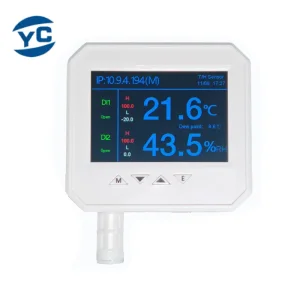
DC12~48V + POE power supply. Designed specifically for critical HVAC environments, Server Cabinets, and Enterprise Data Centers in Riyadh and Jeddah.
View Technical Specs →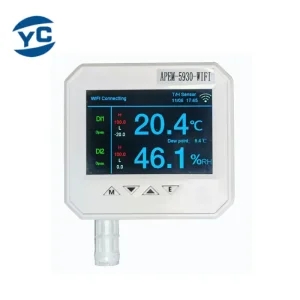
Wired Ethernet (Primary, stable) & Wireless WiFi (Backup, flexible). Ideal for integration into hybrid smart city infrastructures and green building monitoring frameworks.
View Technical Specs →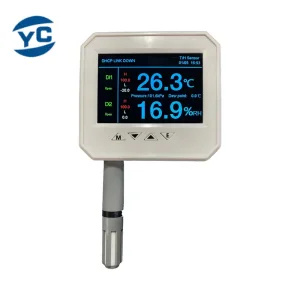
Assesses airflow and controls pressure differentials to prevent cross-contamination. Suitable for cleanrooms, laboratories, and petrochemical laboratories in Dammam.
View Technical Specs →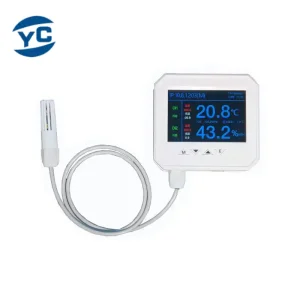
Features a separated probe connected via high-grade cable. Perfect for deep cold storage, incubators, and industrial furnaces where the display unit must reside externally.
View Technical Specs →As the Kingdom of Saudi Arabia advances its historic Saudi Vision 2030, the demand for precise digital ambient monitoring has risen exponentially. Large-scale infrastructural expansions, such as the NEOM Giga-project, the Red Sea Project, and massive technological hubs in Riyadh and Jeddah, are redefining how industrial environments operate. However, operating complex digital systems in the Middle East brings unique, intense localized environmental challenges.
Ambient summer temperatures regularly exceed 50°C. Standard commercial sensors degrade rapidly under these conditions. Our hardware is engineered with Swiss and German high-performance chips designed for long-term operational stability up to 85°C.
Coastal developments (Jeddah, Yanbu, Jubail) face aggressive marine air combined with fine silica dust particles. To counter this, our Ethernet sensor housings offer ingress protection and optional sintered metal filter tips to prevent micro-contamination.
The Saudi Food and Drug Authority (SFDA) enforces strict compliance guidelines for storing and transporting pharmaceuticals and food. Traceable, network-connected temperature and humidity logging with localized audit trails is mandatory.
While wireless protocols (Wi-Fi, Bluetooth) are easy to deploy, they struggle inside heavily reinforced concrete facilities, oil refineries, and data centers shielded against electromagnetic interference. Power over Ethernet (PoE) provides a highly stable, dual-purpose cable infrastructure that delivers clean power and continuous data transmission concurrently. This minimizes power drops, protects critical sensor data from local radio interference, and simplifies cable management in modern facility setups.
Beijing Yingchuanglihe Electronic Technology Co., Ltd. has established itself as an industry-leading manufacturer of high-end environmental sensors. Since 2007, we have specialized in developing innovative ambient telemetry equipment.
A history of engineering breakthroughs, establishing global standards for environmental monitoring solutions.
Company founded. Developed early environmental monitoring terminal based on TCP/IP and introduced initial environment software suite.
Collaborated with Mocha Software to launch the TH-5939 series of environmental sensors supporting SNMP protocols.
Partnered with COMLAB (Switzerland) to launch the TH-5869 protective Ethernet series, utilized across high-speed rail lines.
Cooperated with Founder Technology to launch the APEM-6100 series, pioneering Power over Ethernet (PoE) integration.
Collaborated with Foxconn to establish our sensors as standard components for industrial workshop monitoring systems.
Partnered with Baidu to launch the next-generation APEM-5900 intelligent terminal, successfully deployed in Baidu's Yangquan Data Center.
Launched integrated outdoor cabinet monitoring system, applied in high-reliability Huawei ETC expressway projects.
Delivered autonomous driving road test equipment solutions and edge computing integration boxes in Beijing Autonomous Driving Zones.
Participated in intelligent computing infrastructure design, deploying critical sensors across global hyper-scale data sites.
Established water management & Beidou high-precision tracking divisions. Acquired specialized IDC commercial operation licenses.
Operating precise environmental monitoring equipment within modern smart complexes, cleanrooms, and chemical plants requires a highly robust electrical design. Our sensors feature galvanic isolation to block high-voltage transient spikes, helping prevent ground loops and protect delicate internal microcontrollers.
Enables smooth, native communication with industrial SCADA systems, PLCs, and BMS systems. Facilitates direct registry read-outs of temperature, humidity, dew point, and barometric pressure values.
Allows IT engineers to monitor rack environments directly using existing network management frameworks (Zabbix, PRTG, Nagios) with specialized Management Information Base (MIB) files.
Directly stream localized microclimate telemetry readings into AWS IoT Core, Azure IoT Hub, or local private clouds over secure TCP/IP without requiring expensive intermediate gateways.
| Parameter | Measurement Range | Standard Accuracy | Long-term Drift (Per Year) |
|---|---|---|---|
| Temperature | -40°C to +85°C (Extended probe: -50°C to +120°C) | ±0.3°C (Optional ±0.1°C high precision) | < 0.03°C |
| Relative Humidity | 0% to 100% RH | ±3% RH (Optional ±1.5% RH high accuracy) | < 0.25% RH |
| Atmospheric Pressure | 300 to 1100 hPa | ±12 hPa | ±1.0 hPa |
| Carbon Monoxide (CO) | 0 to 1000 ppm | ±5% F.S. | < 2% signal loss/month |
Select from our highly optimized range of multi-parameter sensors. These options are tailored to monitor air quality, track hazardous gases, and log ambient conditions for industrial safety and regulatory compliance.
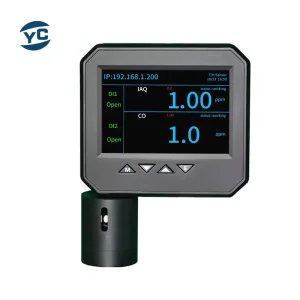
Integrates temperature, humidity, carbon monoxide (CO), and Indoor Air Quality (IAQ) indexes for sustainable green structures.
View Specifications →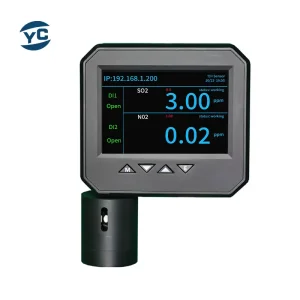
Specifically designed for air quality and gas leakage monitoring in heavy petrochemical and refinery clusters.
View Specifications →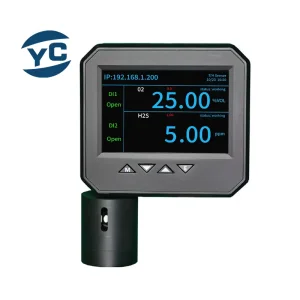
Essential for monitoring oxygen levels and hazardous hydrogen sulfide concentrations in industrial confined spaces.
View Specifications →
A reliable standard for monitoring temperatures in automated distribution and logistics warehouses.
View Specifications →
Monitors indoor environment quality metrics to optimize HVAC performance and reduce carbon footprints.
View Specifications →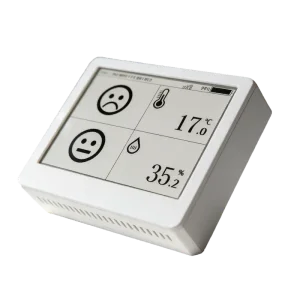
Long-range low-power telemetry designed to monitor agricultural conditions inside smart desert greenhouses.
View Specifications →
Monitors industrial emission safety levels with real-time digital outputs and local alarm indicators.
View Specifications →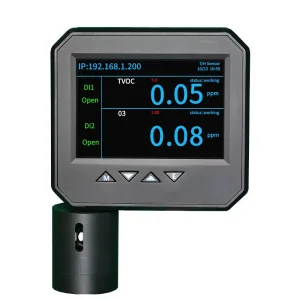
Tracks organic chemical elements and ozone (O₃) concentrations inside semiconductor and medical cleanrooms.
View Specifications →Our environmental sensor solutions have been deployed across several critical projects in Saudi Arabia's major economic and industrial regions.
In high-performance data centers across Riyadh, cooling loads must be managed dynamically to prevent server downtime. APEM-5930 sensors monitor server rack inlets in real-time, feeding ambient environmental data directly to BMS systems using SNMP to optimize energy usage.
Pharmaceutical warehouses in Jeddah and Dammam use our APEM-5930E extended probe sensors to log temperatures within precise calibration limits. These sensors integrate directly with database networks, generating compliance reports that meet SFDA guidelines.
In Jubail's petrochemical plants, monitoring oxygen levels and hazardous gases (such as CO and H₂S) alongside ambient temperature and humidity is critical for safety. Our APEM-5930G series monitors environments inside confined spaces, transmitting real-time safety alerts over Ethernet.
Expert answers regarding our Ethernet temperature, humidity, and gas sensors for industrial projects in the Middle East.
For standard temperature and relative humidity monitoring, we recommend a recalibration cycle of 12 to 24 months. In high-exposure industrial environments with corrosive air or persistent sand dust (such as offshore rigs or desert extraction facilities), we recommend verifying calibration every 12 months. Our built-in Swiss and German sensing chips feature very low drift (less than 0.03°C per year under normal operation).
Yes. The entire APEM Ethernet sensor series supports standard communication protocols: Modbus TCP for industrial PLCs and SCADA software, SNMP (v1, v2c, and v3) for network management suites (like Zabbix, PRTG, and SolarWinds), and MQTT for cloud applications. No proprietary middleware or gateways are required.
SFDA guidelines require continuous, tamper-proof temperature records. Our Ethernet sensors can log data directly to local databases, which supports continuous record keeping. Additionally, the APEM-5930E supports NIST-traceable calibration certificates, which are essential for quality audits and cleanroom compliance.
Yes. The sensors are fully compatible with standard IEEE 802.3af PoE networks. Power is delivered over standard Cat5e or Cat6 Ethernet cabling, eliminating the need for dedicated DC power drops at each sensor location. We also include auxiliary DC terminals (12-48V) for backup power redundancy.
The APEM-5930E separates the sensing elements from the main network module using a high-temperature cable. This allows the probe to be placed inside extreme environments (like cold storage rooms or incubators) while the network transmitter remains outside, maintaining a stable Ethernet connection.
Yes. We offer customization options, including changes to probe housing, custom cable lengths, specific gas integrations, and custom firmware protocols. Our engineering team provides technical support via email or web conference, with responses guaranteed within 8 hours.
 YCLH Sensor