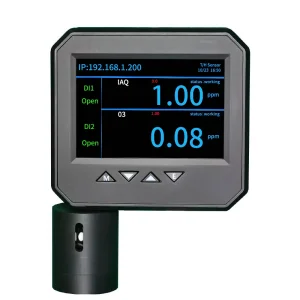
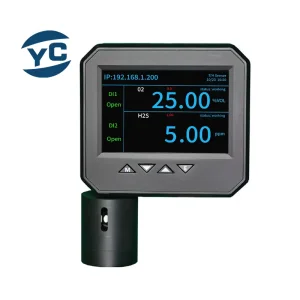
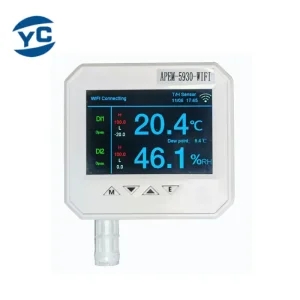
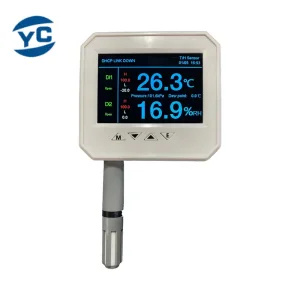
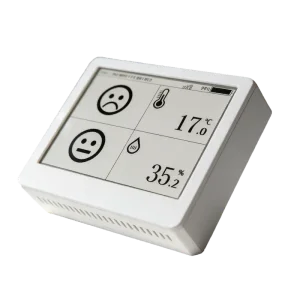
Modern industrial facilities, green data centers, and advanced laboratories are transitioning from single-variable discrete sensors to tightly integrated, heterogeneous multi-parameter sensor arrays.
This integration is not simply placing multiple discrete transceivers inside a single case; it represents a unified electrical architecture, combined clock synchronization, and advanced onboard data logging designed to run digital drift mitigation algorithms. By deploying systems like the APEM-5930G series, facilities achieve a comprehensive microclimate snapshot across temperature, humidity, absolute pressure, TVOCs, ozone (O₃), carbon monoxide (CO), sulfur dioxide (SO₂), and nitrogen dioxide (NO₂) through a single Ethernet IP node.
This technological convergence mitigates network complexity, slashes cabling overhead, and eliminates propagation delays. Utilizing high-performance processing modules connected directly to imported Swiss and German sensing chips, our instruments handle multi-channel analog-to-digital conversions on-the-fly, serving clean, calibrated, and compensated environmental data over industrial protocols such as Modbus TCP/IP, SNMP, and MQTT.
By executing multi-sensor data fusion algorithms directly at the edge, the APEM platform ensures that temperature and humidity fluctuations are dynamically used to self-calibrate and cross-compensate gas sensitivity indexes, yielding unrivaled long-term stability.
Established in 2007, Beijing Yingchuanglihe Electronic Technology Co., Ltd. stands as a pioneer in specialized environmental telemetry. Integrating R&D innovation, strict testing, and scalable factory production, we provide precision-engineered sensors to Tier-1 infrastructure, rail transit systems, high-capacity data centers, and global distribution buyers.
Utilizing high-stability sensing elements imported from industry-leading manufacturers in Switzerland and Germany. This provides NIST-traceable reliability and near-zero drift across thousands of continuous runtime hours.
Fully certified under CE, FCC, and RoHS standards. Our structural designs guarantee electrical interference protection and absolute safety in communication racks, cleanrooms, and municipal settings.
Out-of-the-box integration with building management software (BMS), SCADA systems, and cloud dashboards via Modbus TCP/RTU, SNMP (v1/v2c/v3), HTTP/JSON API, MQTT, and wired/wireless dual-failover options.
Beijing Yingchuanglihe was established in the nation's high-tech center. We launched our initial generation of intelligent environmental monitoring terminals based on native TCP/IP networking, replacing outdated serial-only architectures. Developed version 1.0 of our Proprietary Monitoring Control System Software.
Partnered with Mocha Software, China's leading network management platform, to deliver the TH-5939 series of multi-functional environmental sensors featuring full SNMP architecture support, allowing IT managers to oversee structural server room parameters directly from single network interfaces.
In partnership with COMLAB (Switzerland), we engineered the protective Ethernet environmental monitoring terminal, TH-5869. The devices were installed in mechanical equipment houses along critical railways, including the Beijing-Kowloon, Beijing-Shanghai, and Wuhan-Guangzhou High-Speed Rail corridors.
Collaborated with Founder Technology to construct and launch the APEM-6100. This unit was among the domestic industry's earliest pioneers of integrated Power over Ethernet (802.3af PoE) for telemetry devices, resolving heavy multi-cable runs by merging power and high-speed data transfer into a single RJ45 cable.
Partnered with Taiwan Foxconn to install hundreds of precision multi-parameter temperature and humidity units across delicate manufacturing floors, helping our custom telemetry instrumentation become an industry benchmark for advanced electronics and semi-conductor cleanroom assembly.
Co-engineered the APEM-5900 next-generation Ethernet intelligent environmental controller with Baidu. Installed thousands of nodes at Baidu's Yangquan Hyper-Scale Data Center. Simultaneously expanded the telemetry monitoring system software platform to support high-density concurrent APIs.
Launched our unified smart solutions portfolio to horizontally connect municipal centers, archives, and warehouses. Designed custom integrated IP65 outdoor cabinet monitoring devices used heavily by Huawei and China Merchants Huaruan in high-speed toll expressway ETC installations.
Delivered rugged, high-reliability environmental monitoring units for Beijing's Autonomous Driving Roadside Integration Boxes, facilitating robust vehicle-to-everything (V2X) field testing. By 2023, these custom high-precision arrays were deployed in numerous advanced liquid-cooled and air-cooled HPC computing facilities.
Established targeted environmental telemetry divisions with Beijing Enterprises Water Group, alongside co-founding a Beidou satellite-driven geological deformation monitoring unit with the Beijing University of Civil Engineering and Architecture. Achieved direct industrial ISP and Internet Data Center (IDC) qualification licenses.
Every multi-parameter sensor undergoes systematic, multi-point software-assisted calibration against reference instruments in our custom wind tunnels and specialized thermal environments, delivering guaranteed linearity and repeatability upon installation.
We maintain deep direct relationships with Tier-1 Swiss Sensation and German semiconductor fabricators, giving our production floor early access to silicon elements even during globally constrained supply cycles.
Our five high-efficiency automated processing lines allow us to transition bespoke custom modifications (such as custom length cable extensions, alternative display sizes, or specific firmware configurations) from raw schematic layout to final product within 15 working days.
Modern high-density data centers utilize hot/cold aisle containment structures where even minor thermal spikes can compromise active networking gear. Integrated APEM-5930 Power-over-Ethernet (PoE) Sensor clusters are deployed throughout high-density racks to monitor temperature, relative humidity, dew point, and air differential pressure simultaneously.
This allows automated environmental controllers to regulate HVAC chilling systems dynamically, optimizing Power Usage Effectiveness (PUE) ratios and triggering early warnings before physical hardware begins thermal throttling.
In clinical preparation cleanrooms and sterile vaccine storage nodes, strict regulatory guidelines (such as FDA 21 CFR Part 11 and GMP) mandate absolute containment. Multi-parameter sensors like the APEM-5930P measure absolute atmospheric pressure, humidity, and temperature on-the-fly.
By measuring minute pressure differentials between cleanrooms and surrounding corridors, our devices ensure negative or positive room pressure states are strictly maintained, shielding pristine zones from airborne contaminants.
Preserving fragile historical documentation, ancient wood structures, and fine arts requires tight microclimatic stabilization. Fluctuations in relative humidity invite fungal growth and cellular degradation.
The APEM-5736 long-range wireless LoRaWAN sensor with ultra-low power consumption and passive E-ink display is ideal for historic structures where drilling physical cable channels is strictly prohibited, passing secure data across massive masonry walls for over 5 continuous years on a single field battery swap.
Municipal water pipeline vaults, remote substations, and industrial manufacturing plants face hazardous accumulations of chemicals or explosive/toxic gases. Devices such as the APEM-5930G-O₂-H₂S and CO integrate electrochemical sensing matrices into robust enclosures.
They provide field monitoring of toxic gas concentrations alongside local relay integration. If toxic thresholds are breached, built-in alarms trigger fans and alerts instantly, bypassing software layers to protect human lives.
When architectural engineers design multi-parameter sensor arrays, selecting the ideal physical layer communication protocol is crucial for balancing deployment cost, data frequency, and structural interference.
Designed for mission-critical, high-frequency, near-instantaneous telemetry updates where structured LAN infrastructure is readily accessible.
Engineered for distributed networks spanning expansive agricultural fields, underground pipe conduits, and historical architectural complexes.
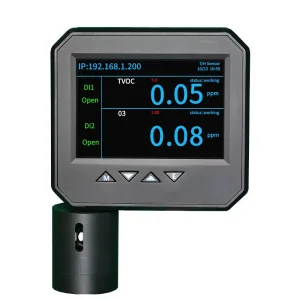
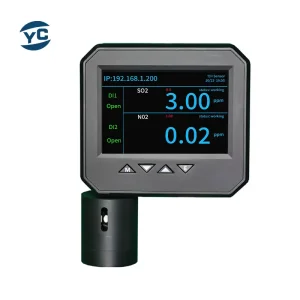
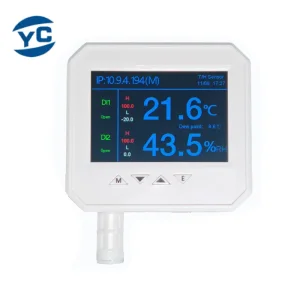
Our multi-parameter sensors are designed as central communication nodes, allowing you to connect complex field systems with your primary cloud monitoring platform.
APEM multi-parameter devices feature direct 10/100 Mbps RJ45 ports (IEEE 802.3af PoE compliant) and robust wireless terminals. External probes use high-flexibility, corrosion-resistant shielding to keep the core electronics safe from harsh environment exposures.
By integrating embedded 32-bit ARM Cortex processing units, our instruments perform edge calculations, manage local data logging intervals, and drive independent relays to control environmental equipment instantly if connections to central servers drop.
Our software integrates with external applications through RESTful APIs, secure WebSockets, and encrypted MQTT broker connections, allowing developers to import environmental data directly into custom ERP, BI, and AI analytics dashboards.
 YCLH Sensor