Direct from our modern production facility: industrial-grade Power over Ethernet (PoE) and remote communication modules certified for critical infrastructure.
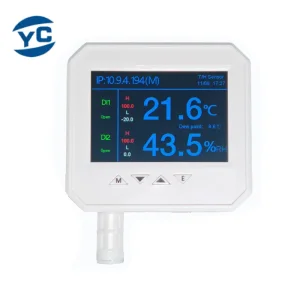
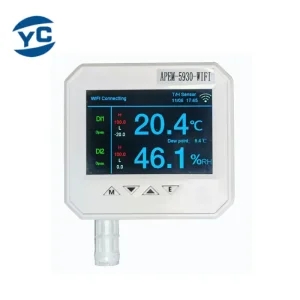
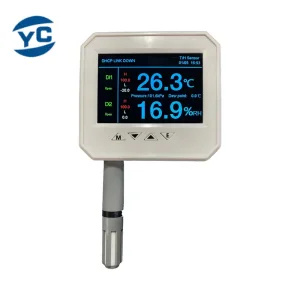
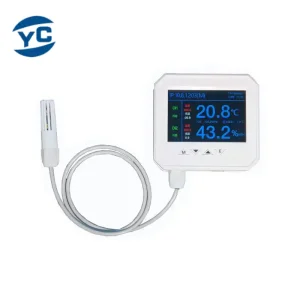
How extreme climate variance and strict cold chain regulations dictate the demand for resilient Ethernet monitoring technology.
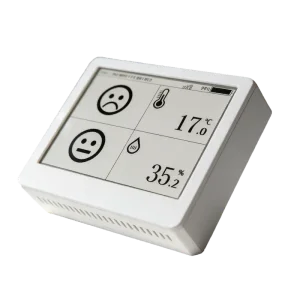
Operating industrial, logistics, and data infrastructure in Canada presents unique thermodynamic challenges. With temperatures dropping below -40°C in Alberta and Saskatchewan during winter, and soaring to over 35°C with high relative humidity in Ontario and Quebec during summer, environmental control systems must adapt instantly. Industrial facilities, cold storage warehouses, and outdoor telecommunication enclosures require highly sensitive Ethernet temperature and humidity sensors to feed real-time atmospheric metrics back to localized building management systems (BMS). Traditional wireless sensors often suffer from localized battery failure or signal degradation due to sub-zero temperatures and thick thermal insulation. Standardizing on Power over Ethernet (PoE) sensors eliminates localized battery vulnerabilities, providing continuous data and power through a single Ethernet run.
Furthermore, Canada’s strict building codes and green facility certifications (such as LEED Canada and the BOMA BEST standard) place a massive premium on energy efficiency. Deploying smart Ethernet-based multi-parameter sensors allows HVAC automation systems to run dynamically. Facilities can scale down heating or cooling power based on accurate humidity index calculations and real-time dew point analysis, lowering overhead costs and cutting overall carbon footprints.
In the pharmaceutical, clinical, and biotechnological sectors, adherence to Health Canada's GUI-0119 guidelines (Guidelines for Temperature Control of Drug Products during Storage and Transportation) is legally mandated. Any failure to maintain precise environmental storage conditions can lead to immediate batch recalls and heavy compliance penalties. Standardized data logging with automated reporting is essential. Industrial-grade Ethernet sensors, featuring local data logging buffers and real-time TCP/IP transmission protocols (such as SNMP or Modbus TCP), ensure that continuous monitoring records are preserved even during localized network disconnects. This creates an unburdensome audit trail for inspectors, verifying that cold rooms, deep freezers, and clean rooms remained strictly within their design envelopes.
For nearly two decades, we have engineered and manufactured high-precision environmental monitoring hardware for global enterprises.
Beijing Yingchuanglihe Electronic Technology Co., Ltd. is a leading high-tech manufacturer specializing in industrial environmental monitoring sensors. Operating from our state-of-the-art 1,500m² facility with five automated assembly lines, we integrate advanced research, manufacturing, and QA systems to ship premium sensors worldwide.
We source high-precision sensing elements exclusively from industry giants in Switzerland and Germany (such as Sensirion and Bosch) to guarantee long-term calibration stability and sub-second sensor response times.
Our hardware natively supports Modbus TCP, SNMP (v1/v2c/v3), MQTT, HTTP, and JSON payloads. Integrate directly into your pre-existing SCADA, BMS, or IT management suites without proprietary gateways.
All environmental sensors comply with CE, FCC, RoHS, and WEEE requirements. We follow strict quality management pipelines, ensuring out-of-the-box reliability for mission-critical tasks.
A track record of technological innovation, standard-setting, and partnership with global giants.
How we tailor sensor integration to protect mission-critical operations across diverse verticals.
Maintain thermal uniformity across server aisles. Our PoE sensors monitor dry-bulb temperatures, relative humidity, and dew point directly at the rack level, helping to prevent equipment corrosion and electrostatic discharge while optimizing airflow cooling loops.
From walk-in freezers to bulk food and vaccine storage, we supply external-probe Ethernet sensors designed to operate at sub-zero temperatures. Continuous logging guarantees regulatory compliance with automated warning notifications.
Pharmaceutical labs and semiconductor fabs rely on pressure differential monitoring. Our APEM-5930P monitors relative pressure offsets alongside temperature and humidity, preventing cross-contamination from clean zones to gray zones.
Unlocking IoT scalability with edge-native intelligence, enhanced protocols, and sensor fusion.
Legacy deployments of analog industrial sensors require separate lines for power and signal transmission. This dual-cabling model escalates construction and labor costs, particularly in sprawling warehouses or high-rise commercial structures. By standardizing on IEEE 802.3af Power over Ethernet, our sensors consolidate low-voltage power supply and high-speed data transmission onto a single Cat5e/Cat6 patch cable. This architecture simplifies installations, reduces points of failure, and allows IT engineers to reboot individual sensors remotely using standard managed PoE switches.
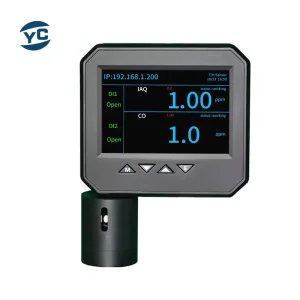
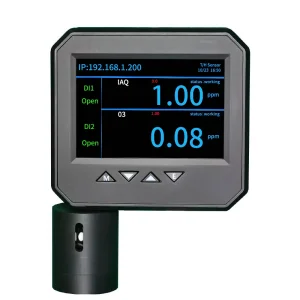
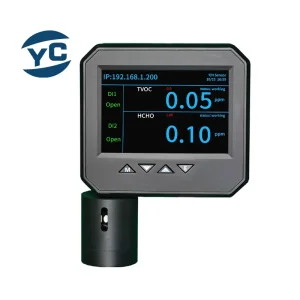
Modern industrial buildings require holistic, real-time indoor air quality (IAQ) and chemical safety metrics. Our product roadmap embraces multi-parameter integration. Models like the APEM-5930G fuse relative humidity and temperature with TVOC, ozone (O₃), sulfur dioxide (SO₂), carbon monoxide (CO), and formaldehyde (HCHO) analysis. Instead of deploying separate, isolated sensors, industrial clients can use a single IP address to manage complete ambient monitoring, saving cost and network bandwidth.
As IoT transitions away from centralized cloud computing, localized processing has become essential. Our sensors feature internal microcontrollers that calculate dew point values locally, trigger dry-contact relays, and push alarm states via SNMP Traps or MQTT messages before routing data to central databases. Native integration with Modbus TCP makes the devices directly compatible with industrial PLC systems (such as Allen-Bradley or Siemens), bridging the gap between typical IT networks and operational technology (OT) SCADA platforms.
Combining world-class production line speed with stringent QA testing and customization capabilities.
Operating out of our 1,500m² production base, five automated SMT and calibration lines ensure high yield rates, swift execution, and competitive unit costs on volume orders.
Every sensor goes through a multi-stage thermal and moisture calibration process in automated environmental chambers, ensuring accurate tracking across the entire operating range.
Whether you require custom enclosure branding, specialized sensor probe cable lengths, or firmware adaptations, our dedicated R&D team can rapidly design and ship prototypes.
Our factory operates with direct access to regional component hubs, protecting our supply chain from raw material bottlenecks. We maintain a safety stock of imported Swiss Sensirion chips, allowing us to keep lead times stable for global clients. With rapid transport networks routing shipments through major international hubs, we regularly supply systems to clients in Canada, the EU, and the USA.
Providing seamless localization, technical support, and strict compliance alignment for Canadian projects.
Our hardware matches the strict electrical compliance requirements of Canadian authorities. Devices carry FCC/IC approvals, ensuring they meet electromagnetic interference limits in residential and commercial zoning.
Upon request, we offer sensors with calibration certificates traceable to international standards (including NRC/NIST equivalent calibration certificates), simplifying compliance for regulated facilities.
Our dedicated global support division provides guaranteed responses to system integration queries within 8 hours. We supply comprehensive SDKs, Modbus register maps, and MIB files to ensure setup is straightforward.
Explore our full range of network sensors and data loggers. Choose the exact configuration for your environment.
Detailed technical advice on selecting, installing, and managing Ethernet environmental sensors.
Traditional wireless sensors run on batteries that degrade rapidly in cold temperatures (typically dropping in performance below 0°C). PoE (Power over Ethernet) provides continuous power and data connectivity through a single copper network cable, removing battery maintenance entirely. PoE switches can also be connected to a centralized UPS system, ensuring the sensors remain online during utility power failures.
Yes. Our sensors natively support Modbus TCP and SNMP, allowing them to communicate directly with programmable logic controllers (PLCs), SCADA software, and standard BMS platforms. By utilizing open TCP/IP based APIs, developers can pull JSON formatted sensor data directly over HTTP, making integrations straightforward.
Our integrated Swiss and German sensing elements have a drift rate of less than 0.25% Relative Humidity and 0.03°C per year under normal operating conditions. For regulated environments like Health Canada compliant pharmacies or semiconductor cleanrooms, we recommend testing or recalibrating the units every 12 to 24 months. Traceable calibration documents can be supplied upon order.
Yes. Multiple models feature built-in hardware relays or local alert configurations. Users can set maximum and minimum thresholds for temperature or humidity. If thresholds are crossed, the sensor can trigger local relays to sound an alarm or activate ventilation systems, even if there is a network dropout.
Yes. Our sensors carry FCC, CE, and RoHS approvals, meeting the electromagnetic compliance requirements set by Industry Canada (ICES-003). The low voltage design (using IEEE 802.3af PoE or DC 12-48V inputs) simplifies local electrical safety certifications.
Get in touch with our engineering team for customized solutions, volume pricing, and calibration options for your Canadian facilities.
Send Inquiry Now YCLH Sensor