Highly stable, multi-protocol Ethernet and Wireless monitoring devices engineered for modern high-density server rooms, edge computing racks, and data centers.
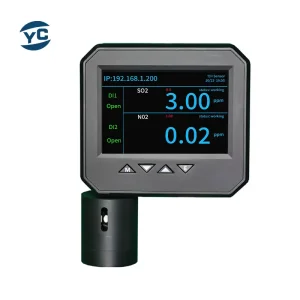
Specialized for server rooms vulnerable to atmospheric corrosion. Tracks temperature, RH, SO2, and NO2 to prevent component failures.
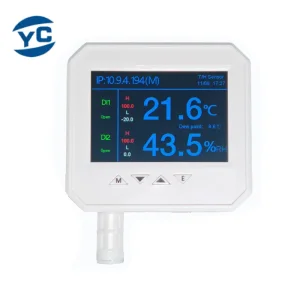
Industry-standard PoE monitoring device providing seamless Ethernet connectivity, eliminating external power supply overhead.
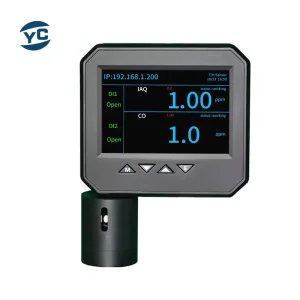
Comprehensive indoor air quality assessment integrating carbon monoxide levels alongside high-precision temperature logging.
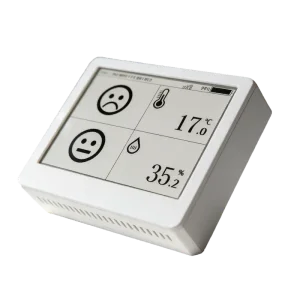
Ultra-low power wireless sensor ideal for highly distributed data structures and expansive server facility monitoring.
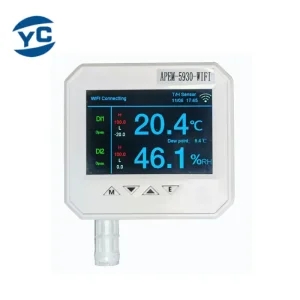
Hybrid connectivity model designed for flexible deployment scenarios across dynamic, evolving server racks.
Fully compliant with European CE regulatory framework. Ensures reliable deployment across international data infrastructure.
Exceptional battery-efficient design, reducing hardware maintenance overhead in complex infrastructural frameworks.
Hardened enclosure designed to withstand diverse environments, ensuring structural protection and sensor accuracy.
In the era of hyper-scale computing, hyperscalers, and edge artificial intelligence, data centers represent the backbone of global economic enterprise. As computing density rises, thermal management becomes a critical operational concern. Standard server racks that once consumed 5kW are now regularly exceeding 20kW to 50kW, pushed to the limit by dense CPU and GPU infrastructure. In this high-thermal environment, cooling inefficiencies or localized overheating can trigger thermal runaway, catastrophic hardware failures, and millions of dollars in unplanned downtime.
Consequently, global enterprise procurement of server room temperature monitoring devices has moved beyond simple ambient thermostats. Procurement teams require highly granular data networks with precise sensor hardware. Advanced facilities mandate monitoring at the rack level (inlet, outlet, top, middle, and bottom) to map micro-environmental patterns and dynamic thermal characteristics.
Modern data infrastructure aligns with ASHRAE TC 9.9 thermal criteria. Monitoring solutions must deliver continuous, certified accuracy (±0.3°C and ±2% RH) to enable running operations safely up to 27°C (80.6°F) to optimize cooling efficiency.
Hardware must natively interface with DCIM (Data Center Infrastructure Management) software, Building Management Systems (BMS), and industrial NMS environments via SNMP (v1, v2c, v3), Modbus TCP/RTU, and lightweight MQTT protocols.
System administrators cannot tolerate frequent sensor replacement or drift calibration. Devices must offer high mean time between failures (MTBF > 100,000 hours) and minimal drift characteristics (<0.03°C annual drift).
The reliability of Beijing Yingchuanglihe Electronic Technology Co., Ltd.'s hardware starts at the component level. By utilizing premium imported sensor chips from industry-leading manufacturers in Switzerland and Germany, we deliver devices that guarantee rapid thermal response and structural integrity.
Traditional low-cost monitoring units suffer from slow thermal response curves and high vulnerability to humidity saturation. Our APEM series, such as the APEM-5930 Power over Ethernet Sensor, uses a polymer-based capacitive relative humidity sensor and a band-gap temperature sensor on a single monolithic chip. This layout protects against thermal and chemical hysteresis while maintaining high response dynamics.
| Technical Characteristic | Standard Industrial Device | Yingchuanglihe APEM Series | Operational Value Delivered |
|---|---|---|---|
| Core Chip Technology | Domestic Low-tier Integrated Modules | Imported Swiss & German MEMS Chips | Precision stability and reduced calibration cycles. |
| Temperature Accuracy | ±1.0°C to ±1.5°C range | ±0.3°C (standard) / up to ±0.1°C (optional) | Allows high-temperature operation to save HVAC energy. |
| Humidity Response Time (τ63%) | >15 seconds under normal airflow | <4 seconds with proprietary protective filter | Fast detection of humidity spikes and condensation risks. |
| Power over Ethernet (PoE) | External passive splitter required | Native IEEE 802.3af standard compliance | Reduces structured cabling and infrastructure costs. |
| Multi-Protocol Support | HTTP REST API Only | SNMP v1/v2c/v3, Modbus TCP, MQTT, JSON | Seamless integration with legacy BMS and modern cloud platforms. |
Founded in 2007 in Beijing, Yingchuanglihe (YCLI) is an established high-tech enterprise dedicated to environmental sensors, modern manufacturing, and strategic alliances.
Company founded. Developed the first intelligent environmental monitoring terminal based on native TCP/IP network protocol alongside YCLI proprietary tracking software.
Partnered with Mocha Software to release the TH-5939 series of environmental monitors supporting SNMP for corporate enterprise deployment.
Collaborated with Switzerland's COMLAB to develop the TH-5869 protective Ethernet monitor, deployed across high-speed rail lines including Beijing-Kowloon and Beijing-Shanghai railways.
Partnered with Founder Technology to launch the APEM-6100, one of the earliest environmental sensors incorporating integrated Power over Ethernet (PoE).
Formed a supply partnership with Foxconn, establishing YCLI environmental hardware as an operational standard within high-volume electronics production workshops.
Partnered with Baidu to deploy the next-gen APEM-5900 intelligent terminal across Baidu's Yangquan Data Center. Upgraded software architecture to support multi-parameter environmental telemetry.
Launched the integrated outdoor cabinet monitoring system, deployed in highway infrastructure projects with Huawei and China Merchants Huaruan.
Engineered edge computing road test boxes and high-precision roadside integrated sensing nodes for Beijing's autonomous driving test zones.
Participated in key national intelligent computing center projects, delivering essential thermal monitoring systems for GPU supercomputing facilities.
Established joint divisions with Beijing Enterprises Water Group and BUCEA for Beidou deformation monitoring. Earned IDC operator business credentials.
Environmental tracking goes beyond measuring air temperature. Modern infrastructure requires multi-parameter data collection. In highly complex deployments, secondary threats like corrosive gases, hydrogen accumulation in battery rooms, ozone degradation, and liquid water egress represent significant risks.
Our comprehensive solution architecture integrates multiple monitoring vectors into a unified environmental management framework:
Hot/cold aisle configuration, rack-level telemetry, dew point calculation to prevent condensation, and integration into existing SNMP networks.
Protective housings with external sensor probes (APEM-5930E) to separate active processing logic from harsh manufacturing environments.
Ultra-stable relative humidity and temperature logging to preserve sensitive historical artifacts, manuscripts, and artistic pieces.
Select from our range of industrial-grade multi-parameter environmental nodes, custom air quality monitoring gateways, and high-performance sensor packages.
Designed for harsh environments, tracking corrosive atmospheric constituents to extend server lifespan.
Combines temperature, humidity, carbon monoxide (CO), and Indoor Air Quality (IAQ) tracking in one PoE device.
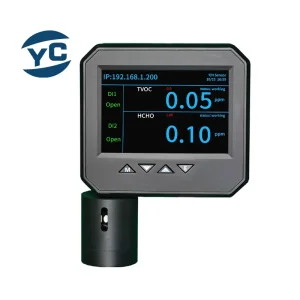
Accurately tracks volatile organic compounds and formaldehyde levels to ensure safe indoor working conditions.
Provides reliable wireless environmental monitoring for multi-story buildings and complex facility layouts.
Enterprise-grade multi-sensor tracking chemical vapors, ambient humidity, and temperature anomalies.
Flexible network interface featuring automated fallback from WiFi to wired RJ45 to prevent telemetry gaps.
Reliable chemical environmental logging, serving as a critical telemetry node for smart ventilation and HVAC control.
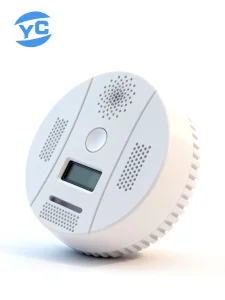
High-performance LoRaWAN standard node designed to integrate into public or private LoRa network topologies.
As data systems transition toward liquid cooling frameworks (direct-to-chip or immersion setups), environmental monitoring requirements are shifting from air parameters to precise liquid thermal tracking. In liquid-cooled environments, detecting coolant leakage and chemical degradation is critical.
Yingchuanglihe is developing next-generation immersion-safe temperature probes and smart leak detection cables. Our roadmap includes integrating localized edge computing into each monitoring terminal. Rather than routing all data to a centralized DCIM platform, future APEM nodes will perform local predictive trend analysis, identifying potential thermal events before they impact hardware.
Furthermore, we are expanding our wireless IoT sensor lines. By upgrading our LoRa and LoRaWAN hardware, we aim to extend battery life beyond 7 years while maintaining standard data reporting intervals.
Delivering monitoring hardware to international markets requires strict compliance with global technical and environmental safety standards. Beijing Yingchuanglihe maintains certified manufacturing and testing facilities to meet these requirements:
Frequently asked questions regarding server room environmental management, sensor installation, and integration protocols.
 YCLH Sensor