China Top 10 HVAC Monitoring Sensors Manufacturers? This guide examines the companies shaping China’s growing HVAC measurement industry. HVAC Monitoring Sensors now support temperature, humidity, pressure, airflow, carbon dioxide, and refrigerant-related monitoring. These small devices influence comfort, energy use, maintenance decisions, and equipment protection.
Professor Shengwei Wang, a recognized building energy and control researcher, has stated, “Reliable sensing is the foundation of intelligent building control.” His point remains practical. A sensor mounted above a dusty ceiling may face heat, vibration, condensation, and unstable wireless signals. Laboratory accuracy alone cannot explain its performance there. Field installation matters.
This selection considers sensor accuracy, calibration practices, product range, communication protocols, manufacturing experience, technical support, and documented applications. It also looks at how manufacturers manage quality before products reach hospitals, offices, factories, data centers, and residential buildings. Standards and certifications provide useful evidence, but they do not replace independent testing or installer feedback.
A ranking is never perfect. Product specifications change. Regional service quality can vary. Some manufacturers communicate their strengths clearly, while others provide limited public data. That limitation deserves attention. Buyers should verify calibration certificates, operating ranges, response times, warranty terms, and compatibility with BACnet, Modbus, or building management systems. The following overview offers a practical starting point, not a final verdict. Its purpose is to help engineers, contractors, and facility owners compare China’s leading HVAC Monitoring Sensors manufacturers with greater confidence.
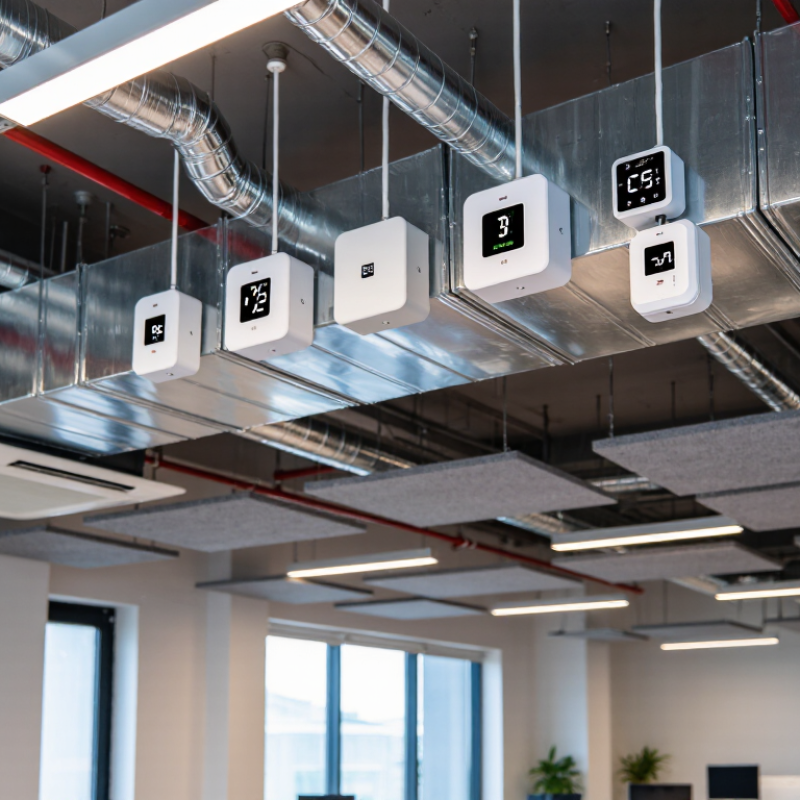
HVAC sensor market scope now extends beyond temperature measurement. It includes humidity, pressure, carbon dioxide, airflow, occupancy, and refrigerant monitoring. These devices support offices, hospitals, factories, data centers, and cold-chain facilities.
Field commissioning shows that a stable reading matters more than a crowded product catalog. A sensor drifting by 0.5°C can affect comfort, energy use, and control decisions.
Selecting China’s top ten manufacturers requires clear, repeatable criteria. Product coverage is only one part. Buyers should examine calibration records, measurement accuracy, response time, operating temperature, and protection ratings.
Communication compatibility also matters. Common interfaces include 4–20 mARS-485major building automation protocols.
Factory audits should review testing equipment, traceability, incoming material checks, and batch consistency. Ask for sample reports, not only certificates.
Service reveals practical strength. Does the supplier provide wiring diagrams, installation guidance, replacement policies, and technical support across time zones? Custom enclosure design can help in dusty plant rooms or damp mechanical spaces.
Cybersecurity and firmware control deserve attention for connected sensors. However, public ranking data is often incomplete. Some manufacturers disclose little about failure rates or long-term drift. That weakness should influence evaluation.
Pilot testing remains wise, even when specifications look convincing. Small details matter.
When comparing China’s top ten HVAC monitoring sensor manufacturers, temperature accuracy deserves close attention. A stated ±0.2°C tolerance can support stable indoor comfort and reliable building automation decisions. However, this figure usually applies under controlled laboratory conditions. Installation errors can reduce real-world performance.
Experienced facility engineers check calibration reports, sensing elements, response time, and long-term drift. They also examine operating ranges, enclosure protection, and communication compatibility. A sensor placed near a supply grille may report artificially low temperatures. Wall exposure can create the opposite problem. Small details matter.
Look for manufacturers that provide traceable calibration procedures and clear testing data. Independent laboratory evidence strengthens technical credibility. Digital outputs can simplify integration with automation controllers, while 0–10 V and 4–20 mA signals remain practical for many systems. Fast response is useful in variable-air-volume zones, but excessive sensitivity may cause unstable control.
The imperfect part is field maintenance. Even accurate sensors need periodic verification. Dust, humidity, wiring faults, and aging components can change readings gradually. A sensible purchasing review should compare accuracy, repeatability, documentation, service capacity, and total operating cost. The cheapest option may not remain economical after repeated recalibration or replacement.
China’s Top 10 HVAC Monitoring Sensor Manufacturers?
Selecting HVAC sensors requires more than comparing prices. Humidity, CO₂, and PM2.5 sensors should support ventilation decisions under ASHRAE 62.1 principles. CO₂ readings can indicate occupancy-related ventilation demand. However, CO₂ is not a complete indoor air quality measurement. A low reading does not prove clean air.
Humidity sensors need stable performance across occupied spaces, return ducts, and outdoor air intakes. Poor placement can create misleading results. PM2.5 sensors need protection from dust buildup and condensation. Their optical readings may drift near kitchens, workshops, or construction areas. That assumption can fail.
During commissioning, check response time, calibration records, temperature compensation, and long-term drift. Choose manufacturers offering traceable testing and clear installation guidance. BACnet or Modbus support can simplify integration with building management systems. Still, communication compatibility does not guarantee accurate data. Field verification remains necessary.
For a practical comparison of China’s leading ten manufacturers, review sensor repeatability, calibration intervals, enclosure quality, and after-sales engineering support. Ask whether replacement probes are available locally. Test readings beside a calibrated reference instrument. Small differences matter. A sensor that performs well in a laboratory may struggle in a humid mechanical room. Reliable monitoring comes from sound hardware, correct placement, and regular maintenance.
Manufacturer-neutral reference values for evaluating HVAC monitoring sensors in buildings designed around ASHRAE 62.1 ventilation principles.
The chart uses a 60% RH upper comfort reference, a 1,000 ppm CO₂ operational indicator, and a 15 µg/m³ PM2.5 24-hour guideline from the WHO 2021 air-quality guidelines. ASHRAE 62.1 establishes ventilation requirements but does not define one universal indoor limit for humidity, CO₂, or PM2.5; project-specific requirements and outdoor-air conditions should therefore be considered.
China’s top ten HVAC sensor manufacturers are best compared through products, certifications, and field data.
Their portfolios commonly include temperature, humidity, CO2, VOC, pressure, airflow, and refrigerant-leak sensors. Typical outputs include 0–10 V, 4–20 mA, Modbus RTU, and BACnet MS/TP. These interfaces support boilers, chillers, air-handling units, and smart-building controllers. The International Energy Agency reports that buildings consume about 30% of global final energy. Accurate sensing can therefore reduce unnecessary heating, cooling, and ventilation.
Product reliability depends on more than a catalog. Buyers should check calibration procedures, sensor drift, response time, operating range, and enclosure protection. Many leading Chinese suppliers provide ISO 9001 quality management certification. Selected models may also carry CE, RoHS, IEC 60730, or China Compulsory Certification documentation, depending on application and market. The ISO 50001 framework is also useful when evaluating energy-management integration. However, certification claims require document verification. A certificate alone does not prove stable field performance.
Tips: Request three years of calibration records, sample test reports, and communication-protocol details. Compare CO2 accuracy at 400–2,000 ppm, not only the headline specification. Ask whether testing uses traceable reference instruments. This matters. MarketsandMarkets’ HVAC sensors research identifies energy efficiency and connected building controls as major demand drivers through the decade. Still, published market forecasts can differ widely. That uncertainty deserves attention. A practical evaluation should combine laboratory data, installation feedback, and long-term maintenance costs rather than relying on rankings alone.
China Top 10 HVAC Monitoring Sensors Manufacturers: BACnet, Modbus, 0–10 V, and 4–20 mA Integration Capabilities
China’s leading HVAC sensor manufacturers increasingly support BACnet and Modbus integration. These protocols help sensors communicate with building management systems, controllers, and energy platforms. BACnet is useful for structured building data and alarm handling. Modbus remains practical for meters, gateways, and compact automation panels. During commissioning, I check register maps, baud rates, device addresses, and timeout settings. Small configuration errors can create misleading readings.
Analog compatibility still matters. Many manufacturers provide 0–10 V outputs for pressure, temperature, and humidity transmitters. Others offer 4–20 mA signals for longer cable runs and industrial environments. A 4 mA starting point can reveal a broken wire more clearly than a zero-voltage signal. Cable shielding, grounding, and power supply stability also influence accuracy. The installation room matters.
A credible top-ten evaluation should examine more than product catalogs. I would review calibration records, response time, ingress protection, protocol documentation, and field support. Factory tests are valuable, but site performance can differ. A sensor may pass laboratory checks and still struggle near variable-frequency drives. That is an uncomfortable detail. Real commissioning data deserves more weight than polished claims. Sensor replacement, firmware updates, and gateway compatibility should be tested before large-scale deployment.
Accurate readings support stable indoor comfort and better control decisions. A stated ±0.2°C tolerance usually reflects laboratory conditions. Field performance may differ.
Yes. A sensor near a supply grille may report an artificially low temperature. Wall exposure can produce warmer readings. Small details matter.
Request calibration records, testing data, operating ranges, and response-time details. Traceable procedures improve technical confidence. Independent laboratory evidence is helpful.
Digital outputs can simplify controller integration. 0–10 V and 4–20 mA signals remain practical. BACnet and Modbus can also support system communication.
Not always. Fast response helps variable-air-volume zones. Excessive sensitivity may create unstable control. Faster is not automatically better.
They provide useful indicators, but no single reading proves overall air quality. Low CO₂ does not guarantee clean air. That assumption can fail.
Review occupied spaces, return ducts, and outdoor air intakes. Protect particulate sensors from dust and condensation. Kitchens and workshops can cause optical drift.
Compare readings beside a calibrated reference instrument. Check response time, temperature compensation, wiring, and calibration history. Field verification remains necessary.
Dust, humidity, wiring faults, and aging components can gradually change readings. Periodic verification is still needed. No sensor stays perfect.
Compare accuracy, repeatability, calibration intervals, enclosure quality, service capacity, and replacement availability. The cheapest option may require repeated recalibration. Initial price can mislead.
This article presents a practical overview of China’s HVAC monitoring sensor market and explains how to evaluate manufacturers through product quality, measurement accuracy, certifications, production capabilities, and application experience. It highlights the role of temperature sensors with approximately ±0.2°C accuracy in building automation, along with humidity, CO₂, and PM2.5 sensors that support indoor air-quality management and alignment with ASHRAE 62.1 principles.
The overview also compares ten representative Chinese HVAC sensor manufacturers without focusing on brand promotion, examining their product ranges, certification coverage, technical data, and customization capabilities. Special attention is given to integration with common building-control systems, including BACnet and Modbus communication, as well as 0–10 V and 4–20 mA signal outputs. These factors help system integrators, facility managers, and buyers select reliable Hvac Monitoring Sensors for commercial buildings, industrial facilities, and smart-building projects.

YCLH Sensor